Investing in Farmland: Gold with a Coupon
15 October, 2025

The world of alternative assets is vast, but few options offer the stability, tangible value, and
reliable income stream of agricultural land. For decades, institutional and high-net-worth
investors have quietly recognized its unique value proposition, often referring to investing in
farmland as owning "gold with a coupon."
In today’s volatile economic climate, with inflation and market uncertainty on the rise, it’s
important to understand why this comparison is so fitting for a diversified portfolio.
Gold with a Coupon
The comparison to gold highlights farmland's role as an exceptional store of wealth. Like the
precious metal, U.S. farmland is a scarce asset with intrinsic value and increasing demand,
making it a hedge against inflation and a stabilizer during equity drawdowns.
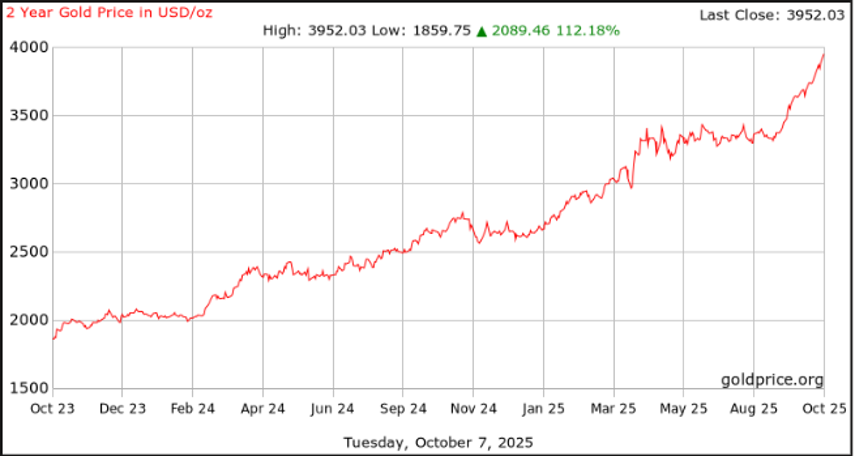
In fact, the price of gold recently hit a major milestone, reaching $4,000 per ounce this month for
the first time ever, demonstrating how hard assets are thriving in the current investment
environment. U.S. farmland investments offer all the stability of gold, which is the "principal
appreciation,” but with a key differentiator: income.
- The "Gold" (Appreciation): Farmland values tend to appreciate over time, driven by global population growth, decreasing arable land supply, and the fundamental, non-discretionary demand for food.
- The "Coupon" (Yield): Unlike gold, which is a non-producing asset, farmland generates annual yield rate that is derived from cash-rent agreements with the farmers cultivating the land.
Why Farmland Makes Sense in Today's Market
The combination of these two features, appreciation and yield, makes farmland stand out in today’s investment environment for several reasons:
- Inflation Hedge & Real Assets: Tangible assets like land tend to retain value when fiat currency declines. Farmland sits at the intersection of scarcity (land) and demand (food, fiber, fuel). U.S. row-crop farmland offers long-term capital appreciation with significantly lower volatility than equities.
- Income Generation: Through cash-rent agreements with tenant farmers or direct crop production, farmland routinely delivers cash flow, a “coupon” that many traditional alternative assets lack.
- Low Correlation to Equity Markets: Farmland historically shows low correlation to stocks and bonds, making it a valuable diversification tool during market stress.
- Growing Global Demand & Limited Supply: With global population growth, rising middle-class incomes, and increasing per-capita food consumption, demand for productive farmland is only rising, even as high-quality irrigated land becomes scarcer.
- Long Time Horizon Fit: Farmland is inherently a long-term investment. It aligns well with institutional investors, family offices, and individuals seeking wealth preservation across generations.
Why the Mid-South Region Offers a Unique Advantage
While U.S. farmland is broadly attractive, certain regions of the country may offer better risk-return characteristics than others. At LFP, the focus is solely on the Mid-South region of the United States (e.g., Arkansas, Louisiana, Mississippi, Tennessee, Kentucky) for a few compelling reasons:
- Groundwater-rich aquifer: The Mississippi River Alluvial Aquifer, which spans the region, is estimated to hold roughly 300 years of groundwater supply, offering a reliable supply of water even during drought years and mitigating climate risk.
- Crop diversity: Unlike single-commodity farms, LFP’s portfolio in the Mid-South supports 10+ crop types (cotton, corn, soybeans, rice, etc.), increasing operational flexibility and reducing commodity-specific risks.
- Relative value: High-quality Mid-South row crop farmland can be purchased for roughly half the price of high- quality Midwest row crop farmland.
Why LandFund Partners?
For investors seeking exposure to farmland as an alternative asset class, LFP offers several differentiators:
- Established track record & scale: LFP’s core team has worked together for over a decade, applying a meticulous due diligence process to assemble a farmland investment portfolio of over 46,000 acres and over 50 different properties.
- Deep regional sourcing & water access: With roughly 93% of the portfolio irrigated and entirely focused in the water-rich Mid-South, LFP targets high-quality farmland.
- Active stewardship: The farm team works on-site on a weekly basis with tenants and operations to drive productivity, soil health, and value creation.
- Sustainability & regenerative agriculture: LFP integrates regenerative practices (e.g. cover-cropping, reduced tillage) across the portfolio, supporting long-term value and environmental impact.
The Right Time to Invest?
In an era when inflation, geopolitical risk, and market volatility are front of mind for many investors, the concept of “gold with a coupon” is more than just a catchy phrase, it’s a framework for understanding how farmland stands apart. By owning a tangible, income-producing asset with inflation-hedging characteristics, investors can bolster portfolio resilience and capture long-term growth.
That’s why farmland investing, when done with a partner who understands land, crops, water, regional dynamics and active stewardship, is increasingly appearing on the radar of high-net-worth investors. At LandFund Partners, our focus on the Mid-South, high-quality irrigated row crop land, active management, and regenerative practices position us well in this market.
If you’re exploring how farmland can play a role in your diversified portfolio, or seeking to go beyond traditional stocks and bonds, we’d be happy to connect and share our full approach, performance data, and how we think about farmland investing in the decade ahead.
To learn more about investing in farmland as an alternative asset:
Get in touch with our team: Investment Interest Form Fill
Newsletter Signup: LFP Newsletter
Email: ir@landfundpartners.com
